In this article (8 sections)
To run an influencer marketing campaign, set one goal and one metric, fix a budget and pricing model, write a clear brief, shortlist creators on audience fit and content quality, agree terms in writing, review content for accuracy and disclosure, launch on a planned schedule, track views and sales, and then move budget toward what worked.
This playbook breaks those steps down for Indian brands, with a brief template, a contract checklist, the disclosure rules that apply in India and a realistic timeline. We use "creator" throughout for the people often called influencers, including YouTubers, Reels creators and meme pages. If you are new to the channel, start with our guide to creator marketing.
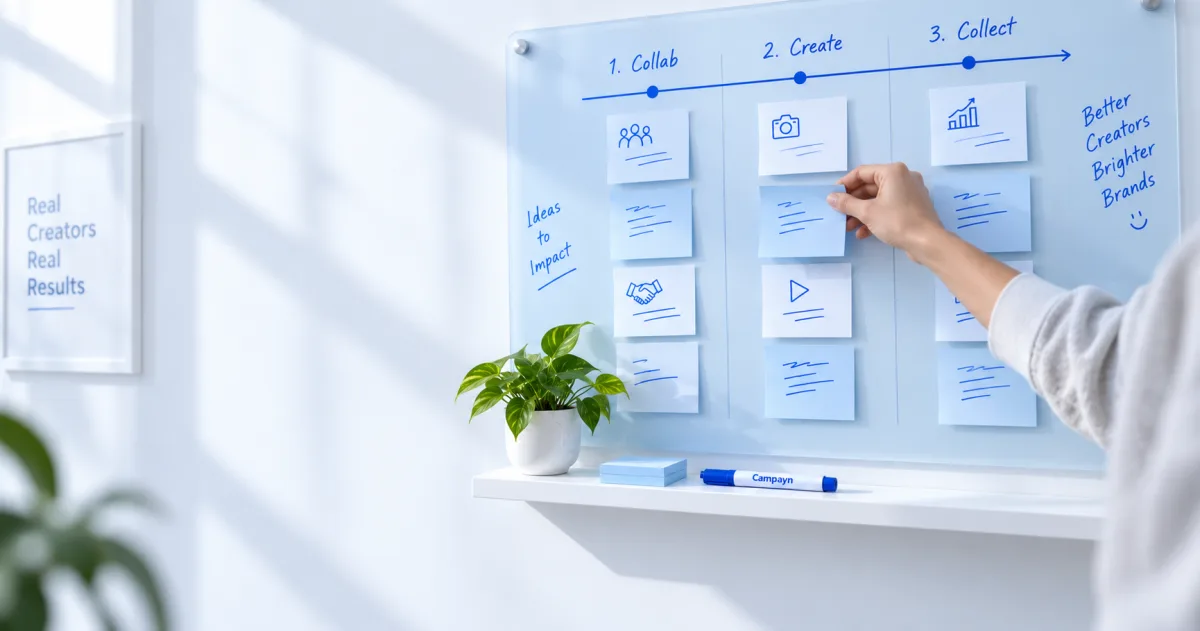
The twelve steps are grouped into Campayn's three campaign stages: Collab, Create and Collect.
| Stage | Steps | Output |
|---|---|---|
| Collab | 1 to 7: readiness, goal, audience, budget, brief, shortlist, terms | Signed creators working from a shared brief |
| Create | 8 to 10: content review, disclosure, launch | Live, compliant content |
| Collect | 11 and 12: tracking, reporting and scaling | A clear read on what worked and what to do next |
Stage 1: Collab
Step 1: Check that your brand is ready
Before spending anything, make sure a curious viewer who clicks through will find reasons to buy. That means a product page or listing that loads quickly and explains the product clearly, some reviews or ratings, an Instagram profile with enough content to look active, and stock to handle a spike in orders. Creator campaigns send attention. They do not fix a leaky funnel.
Step 2: Set one goal and one primary metric
First campaigns most often fail because they try to do everything at once. Pick one goal:
| Goal | Primary metric | Supporting metrics |
|---|---|---|
| Awareness for a launch | Verified views and cost per view | Reach, shares, saves |
| Consideration | Engagement quality | Comments with questions, profile visits, link clicks |
| Sales | Attributed orders | Code redemptions, tracked-link sessions, cost per order |
| Content for ads | Usable videos | How that content performs when run as ads |
Write the goal as one sentence the whole team can repeat. For example: "Reach young professionals in Bengaluru and Hyderabad with a launch message, at or below our target cost per view."
Step 3: Define the audience in concrete terms
Describe who you want to reach the way a creator would recognise them: language, cities, age range, interests and the problem your product solves. "Working women in Pune who want quick, healthy breakfasts" gives a creator far more to work with than "women aged 25 to 40".
Step 4: Set the budget and pricing model
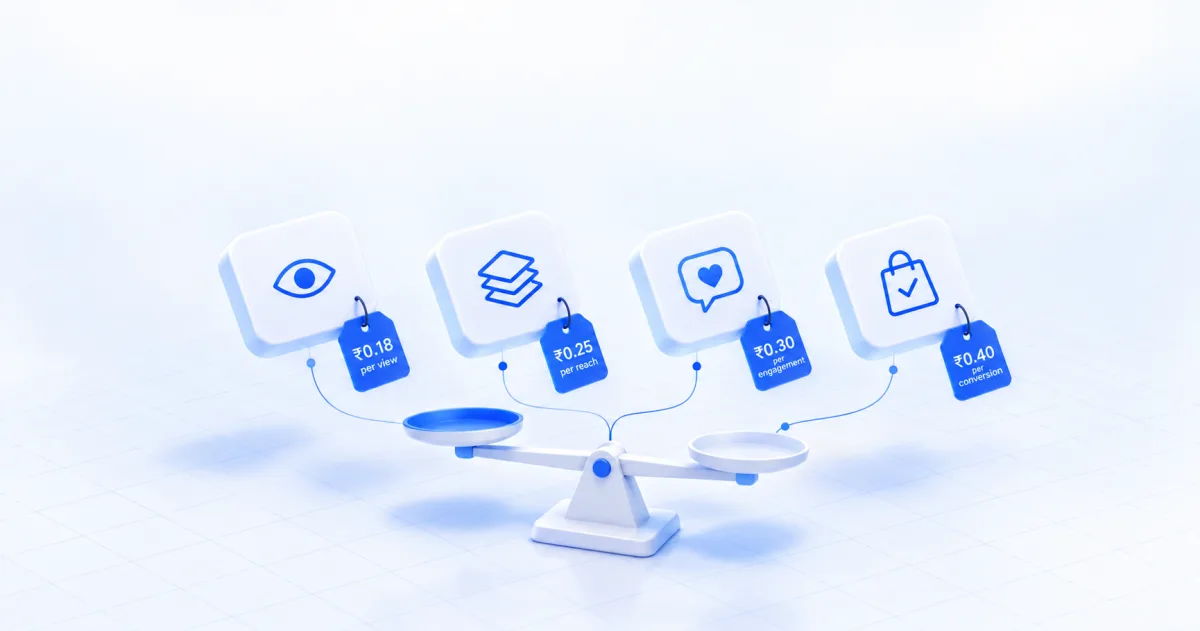
Decide how much you can spend on a test you are willing to learn from, and how you will pay for it. The main options are a flat fee per post, barter, pay per view, commission per sale, or a hybrid. With flat fees, the brand carries all the risk that a post underperforms. With performance-based models, that risk is shared. Our comparison of CPV, CPM, CPE and CPA explains the trade-offs, and our startup budget guide shows what different budgets can deliver.
Include costs beyond creator fees: product and shipping for creators, discounts given through coupon codes, and the time your team spends managing the campaign. Leaving these out is the most common reason campaigns look more profitable on paper than they were.
Step 5: Write the brief
A good brief tells creators what must be true and leaves them free to decide how to say it. Keep it to one or two pages.
| Brief section | What to include |
|---|---|
| Brand in one line | What you sell and who it is for |
| Campaign goal | The one sentence from Step 2 |
| Audience | The concrete description from Step 3 |
| Key message | One message, not five |
| Must-include points | No more than three: a feature, a benefit, the offer |
| Must-avoid points | Claims you cannot substantiate, competitor mentions, sensitive topics |
| Offer and code | The discount, the creator's unique code and when it expires |
| Deliverables | Format, length, number of posts, platforms, Stories or link stickers |
| Timeline | Draft deadline, review window and posting window |
| Disclosure | The exact label and where it must appear |
| Links and tags | Tracked link, brand handle, required hashtags |
| Examples | Two or three pieces of content you like, and why |
The most common brief mistake is over-scripting. Creators know what their audience responds to. A brief that reads like an ad script produces content that looks like an ad and performs like one.
Step 6: Find and shortlist creators
Start from the audience, not follower counts. Look at where your customers already spend time, search relevant topics and hashtags, and check who your competitors and existing customers engage with. Then vet each candidate on audience fit, content quality, typical views across recent posts, engagement authenticity and past brand work.
Shortlist more creators than you plan to book, because some will decline, be unavailable or quote beyond budget. Our guide on how to find the right creators for your brand includes a full vetting checklist and a scorecard.
Step 7: Agree terms in writing
Every collaboration needs a written agreement, including barter deals. At a minimum, it should cover:
- Deliverables: formats, number of posts, platforms, and whether Stories or link stickers are included.
- Timeline: draft deadline, review window and posting dates.
- Review rights: how many rounds of edits the brand can request, and on what grounds.
- Payment: the amount, what triggers it (posting, delivered views or sales) and when it is paid.
- Usage rights: whether the brand can reuse the content, in which channels (including paid ads) and for how long.
- Exclusivity: whether the creator can work with competitors during and after the campaign.
- Disclosure: the creator's obligation to label the content as the guidelines require.
- Authenticity: no bought followers, views or engagement. Campayn's own creator agreement, for example, includes an engagement authenticity clause.
- Corrections and takedowns: what happens if a post contains an error or needs to come down.
Stage 2: Create
Step 8: Review content for accuracy, not personality
Ask for drafts before anything is posted. Check facts, claims, prices, the code and link, how the brand name is said and the disclosure. Resist rewriting the creator's tone, humour or format, because that is what their audience trusts.
If a claim is wrong or cannot be substantiated, ask for a fix. If you simply dislike the style, the lesson is to choose differently next time, not to edit the creator into someone else.
Step 9: Get disclosure right the first time
In India, the ASCI Guidelines for Influencer Advertising in Digital Media apply whenever there is a material connection between a brand and a creator. ASCI defines that broadly: payment, free products (even unsolicited ones), discounts, trips, and family or employment relationships all count. The key requirements are:
- Use a permitted label. Permitted labels include Advertisement, Ad, Sponsored, Collaboration, Partnership, Employee, Free gift and Affiliate, as well as Instagram's "Paid Partnership" tag and YouTube's "Includes Paid Promotion" tag.
- Make it upfront and prominent. The disclosure should not sit only in a bio, at the end of a post, behind a "more" tap or buried among hashtags. ASCI says a platform's disclosure tool should be used in addition to the creator's own disclosure.
- Superimpose it on picture-only or video-only formats. On formats such as Stories, the label must appear over the content itself.
- Keep it on screen long enough. For videos of 15 seconds or less, the label must stay for at least 3 seconds. For videos between 15 seconds and 2 minutes, it must stay for a third of the video's length. For videos of 2 minutes or more, it must stay for the entire section in which the brand is discussed.
- Use the right language. The disclosure must be in English or in the language of the advertisement.
- Share responsibility. The creator must make the disclosure, and the brand is responsible for making sure the published content follows the ASCI code. Where needed, the brand should ask the creator to edit or remove a post.
Put the exact label and its placement in your brief, and check it in every draft.
Step 10: Launch on a planned schedule
Stagger posts across several days rather than publishing everything at once. Staggering lets you learn from the first posts, catch a broken link or code before it affects every creator, and keep the campaign visible for longer. Share the posting calendar with every creator, confirm each post when it goes live, and test every code and link within the first hour.
Stage 3: Collect
Step 11: Track views and sales as the campaign runs
Record verified views, reach, engagement, code redemptions and tracked-link sessions for every post. Take numbers from the creator's platform insights rather than relying only on screenshots, and note the date each number was captured, because views keep rising after posting. Our guide to coupon code and UTM tracking covers the setup in detail.
Step 12: Report, then move budget toward what worked
Compare every creator on the same basis: cost per verified view, engagement quality and cost per attributed order. Then look for patterns across creators, such as which angles, formats, languages and cities worked. Rebook the strongest performers, drop the weakest, and reuse the best content in ads if your usage rights allow. Our guide to measuring influencer marketing ROI explains the formulas and includes a one-page report format.
A realistic timeline for a first campaign
Most first campaigns take four to six weeks from brief to report. Use this as a planning template and adjust it for your category and creators.
| Week | What happens |
|---|---|
| Week 1 | Goal, audience, budget and brief finalised; unique codes and tracked links created |
| Week 2 | Creator discovery, vetting, outreach and written agreements |
| Week 3 | Product reaches creators; drafts made and reviewed |
| Week 4 | Content goes live on a staggered schedule |
| Weeks 5 and 6 | Views and sales tracked; report written and next steps decided |
Common mistakes to avoid
- Choosing creators by follower count alone.
- Working with one creator and drawing conclusions from a single post.
- Over-scripting the brief until the content reads like an ad.
- Creating codes and tracked links after content is already live.
- Leaving usage rights undefined, then wanting to run the best video as an ad.
- Skipping disclosure or hiding it where nobody sees it.
- Judging the campaign on launch day instead of after views and sales have settled.
How Campayn runs this process
Campayn runs the same three stages in one system. Creators are discovered and vetted using the Campy Score, Campayn's AI-based creator rating. Campaigns run end to end through a brand dashboard and a creator app, and views and coupon codes are tracked in the same place. Brands pay on a CPV (Cost Per Verified View) basis, so cost follows delivered attention rather than follower counts. If you are still deciding whether to run campaigns yourself, through an agency or through a platform, see our comparison of agency vs platform vs in-house.
Frequently asked questions
How long does an influencer marketing campaign take to run?
A first creator campaign usually takes four to six weeks from brief to final report. The first two weeks go into planning, the brief and creator selection. Content is typically created and reviewed in week three and goes live in week four, followed by one to two weeks of tracking views and sales before decisions are made.
What should an influencer campaign brief include?
A strong brief includes the campaign goal, a concrete audience description, one key message, no more than three must-include points, claims to avoid, the offer and the creator's unique code, deliverables and timelines, the required disclosure label and placement, tracked links, and a few examples of content the brand likes. It should guide creators without scripting them.
How many creators should a first campaign use?
Use enough creators to compare results rather than betting everything on one person. For a small test, several smaller creators with the right audience usually teach a brand more than one large creator, because differences in angle, format and audience become visible. Shortlist two to three times as many creators as you plan to book.
Do I need a contract for a barter collaboration?
Yes. Even when the only payment is free product, a short written agreement should cover deliverables, timelines, usage rights and disclosure. Under ASCI guidelines, free products count as a material connection, so the creator must label the content as advertising even if they were not paid money.
Can I reuse creator content in my own ads?
Only if the agreement grants usage rights. The agreement should state which channels the brand can use the content in (for example, paid social ads), for how long and whether edits are allowed. Without written usage rights, reposting or advertising with a creator's content can damage the relationship and create legal risk.
What should a brand do if a creator posts without disclosure?
Ask the creator to add a compliant disclosure or edit the post straight away. ASCI guidelines place responsibility on both the creator and the brand, and state that the advertiser should, where needed, ask the creator to edit or delete the post. Including the exact disclosure requirement in the brief and agreement prevents most of these cases.
Sources
- ASCI, "Guidelines for Influencer Advertising in Digital Media" (PDF): https://www.ascionline.in/social/wp-content/uploads/2024/03/ASCI-Guidelines-Influencer-Advertising-In-Digital-Media-1.pdf
Written by Utkarsh Gautam, founder and CEO of Campayn.in. He founded Campayn during his time at IIT Roorkee and leads its product, growth and brand partnerships.
About Campayn.in: Campayn.in is an AI-powered creator marketing platform for Indian brands. Brands launch, manage and measure creator campaigns through one dashboard and pay on a CPV (Cost Per Verified View) basis, with no agency retainer. To plan a campaign, write to contact@campayn.in.